
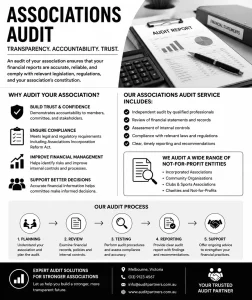
 In Victoria, incorporated association must oblige the Associations Incorporation Reform Act 2012 (the Act). The Act classifies the associations into 3 tiers based on total revenue for the organization’s financial year. These are the tiers that become the basis of the requirements for an associations audit or review:
| Tier | Eligibility (Total Revenue) |
| 1 | < $250,000 |
| 2 | $250,000 – $1 million |
| 3 | > $1 million |
Total revenue refers to the association’s total income from all its activities during its financial year, before deducting any expenses including the cost of goods that it sold.
Record keeping (all tiers)
According to Consumers Affairs Victoria, an association must keep financial records that:
- record and explain its transactions, financial position and performance, and
- allow the preparation of ‘true and fair’ financial statements.
Financial records include:
- invoices
- receipts
- cheques
- documents that record the above (including bank statements)
- working papers and other documents that explain how financial statements are prepared.
The association (the treasurer or the accountant) should maintain and update these records throughout the year as it receives and uses funds.
An incorporated association must keep financial records for seven years.
Preparing financial statements (all tiers)
As soon as practical after the end of the incorporated association’s financial year, the committee must ensure that financial statements are prepared.
An association must present its completed financial statements to members at the annual general meeting (AGM), which must be held within five months after the end of the financial year. The association must lodge these with us within one month after the AGM, along with the appropriate signed declarations.
The financial statements of an incorporated association must give a true and fair view of its financial performance and position during and at the end of the year.
Financial statements must contain:
- income and expenditure (Income Statement) for the association’s financial year
- assets and liabilities (Balance Sheet) at the end of its financial year
- other documents required by accounting standards, such as a cash flow statement
- notes to the account, which must include:
- information required by the accounting standards
- information necessary to give a true and fair view
- information required by the provisions of the Act and its regulations.
In the notes to the account, the association must disclose:
- any mortgages, charges and securities of any description affecting any property of the association at the end of its financial year
- any trust, held on behalf of the association by a person or body other than the association, in which funds or assets of the association are placed
- for each trust your association was a trustee of during any part of its financial year, any:
- income and expenditure (Income Statement) of the trust during that period
- assets and liabilities (Balance Sheet) of the trust during that period
- mortgages, charges and securities affecting any property of the trust at the end of that period.
Review or Audit Requirements
Each tier has its requirements related to review or audit. They are described at the table below:
| Tier | Reporting Requirements |
| 1 | Tier 1 associations can directly report to CAV and no review or audit
is required by the new Act. However, they need to have their financial statements externally reviewed or audited if: · their rules state otherwise (audit or review) · a majority of members vote to do so at a general meeting (review only), or · the Registrar of Incorporated Associations directs them to do so. |
| 2 | The financial statements must be reviewed by an independent accountant, in accordance with Auditing Standards on Review Engagements.
An independent accountant must be: · a member of, and hold a current practising certificate issued by either CPA Australia, the Institute of Chartered Accountants in Australia or Institute of Public Accountants, or · any other suitably qualified person approved by the Registrar of Incorporated Associations for this purpose, such as a members of the Association of Taxation and Management Accountants holding a current practising certificate.
If the rules of your association state that its financial statements must be audited. The auditor’s report may be submitted, together with the financial statements, to members at the AGM. The association does not also need to have its accounts reviewed by an independent accountant.
The audit must comply with the Australian Auditing Standards. |
| 3 | The financial statements must be audited by an independent auditor in accordance with the Australian Auditing Standards.
The independent auditor must be: · a registered company auditor or firm · a member of, and hold a current practising certificate issued by either CPA Australia, the Institute of Chartered Accountants in Australia, or the Institute of Public Accountants, or · any other suitably qualified person approved by the Registrar of Incorporated Associations for this purpose.
The independent auditor must not be: · a member of the association’s committee · an employer or an employee of a member of the committee · a member of the same partnership as a member of the committee · an employee of the association. |
Financial statements lodged with us from associations in tiers 2 and 3 may be inspected by the general public. They must be prepared in accordance with the Australian Accounting Standards issued by the Australian Accounting Standards Board. The statements may be either:
- general purpose financial statements, which are appropriate for larger entities whose financial health may be of interest to a range of external stakeholders (including funding bodies), or
- special purpose financial statements, which provide a less comprehensive set of disclosures than general purpose financial statements, and are appropriate for smaller entities with few or no external stakeholders.
The committee of the association determines which type of statement should be prepared. It should do so in line with the ‘reporting entity’ concept defined in the Australian Accounting Standards.
Financial controls
During review and audit of association, it is important to ensure that the right policies and procedures are in place, thus the financial information of the association is accurate and protected.
A financial control is a procedure that is implemented to detect and prevent errors, theft or fraud, or policy non-compliance in a financial transaction process. Financial control procedures can be implemented by either an individual or as part of an automated process within a financial system.
Each financial control procedure is designed to fulfil at least one of these 7 criteria:
- Completeness
Ensures that all records and transactions are included in the reports of the club
- Accuracy
Ensures that the right amounts are recorded in the correct accounts
- Authorisation
Ensures that the correct authorisations are in place to cover such things as approval, payments, data entry and computer access
- Validity
Ensures that the invoice is for work performed or products received and the club has incurred the liability properly
- Existence
Ensures the existence of assets and liabilities. Has a purchase been recorded for goods or services that have not yet been received? Do all assets on the books actually exist? Is there correct documentation to support the item?
- Handling errors
Ensures that procedures are in place to ensure that errors in the system have been identified and corrected
- Segregation of duties
Ensures that certain functions are separated. For example, the person taking cash receipts does not do the banking.
The auditor will need to be provided with:
- The books of account, consisting of the cashbooks written up and balanced for the year, and journals and ledger if these records are maintained
- Bank statements for the whole year
- Copies of deposit slips and cheque butts
- Receipt books containing the duplicates of receipts issued as well as cancelled original receipts; the auditor also needs to sight books of unused receipts
- Vouchers for payments made, which should be placed in the numerical sequence of cheques drawn
- Access to ‘paid’ cheques from the club’s bankers – unless receipts have been obtained for all payments made
- A copy of the minutes book to enable the auditor to review approvals for major items of income and expenditure
- A copy of the last audited statements of account
- The financial statements for the year now being subjected to audit, together with all supporting working papers
- Any other records or evidence the auditor may request to confirm the accuracy of transactions recorded and the existence of assets and liabilities shown in the books of account and the financial reports.