
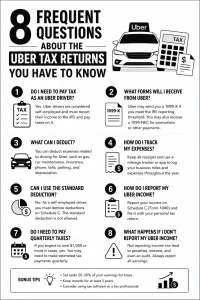
 8 Frequent Questions About Uber Tax Returns You Need to Know
If you’re an Uber driver looking for a tax accountant to handle your Uber tax return, your search ends here.
At A One Accountants, we’ve prepared and lodged hundreds of Uber tax returns. We know the ins and outs of ride-sharing tax laws so you don’t have to. Below, we’ve compiled the most frequent questions our clients ask. No confusing jargon. Just straightforward responses to help you confidently prepare your next Uber tax return.
Q1: Do Uber drivers work for Uber as employees or as independent contractors?
You are an independent contractor. Not an employee.
Here’s why: You personally provide ride-sourcing services to customers through a platform you choose. The word “you” is important here because it means you run your own business. You provide the car, the fuel, the insurance, and the time.As an independent contractor, you must hold an active Australian Business Number (ABN).
Q2: Do Uber drivers need to register for GST?
Yes, with one exception.
If you drive for Uber (ride-sharing), you must register for GST – no matter how much you earn. There is no threshold.
The only exception is if you only do Uber Eats (food delivery). The standard $75,000 GST threshold is applicable in the scenario.
Q3: My Uber income was below $18,200. Should I still submit a tax return?
Yes.
All Australian residents who hold a Tax File Number (TFN) need to lodge a tax return. Uber drivers are no exception.
Even if you earned less than the tax-free threshold, the ATO still expects a return. If you’re unsure, give us a call – we’ll check your situation for free.
Q4: What car-related expenses can I claim?
One significant benefit for Uber drivers is that you can deduct a significant amount of your automobile expenses from your taxes.
Based on your logbook records, you can claim any expense tied to using your car for Uber trips. That includes:
• Fuel
• Repairs and servicing
• Insurance
• Registration
• Car cleaning (if used for Uber)
The key is keeping a logbook for at least 12 continuous weeks to determine your business-use percentage.
Q5: What other expenses can I claim on an Uber tax return?
Uber tax returns are more complex than they look. The ATO uses sophisticated data matching – they cross-check your tax return against bank deposits and the information Uber sends them directly.
That means your return needs to be accurate. And your deductions need to match your lodged Business Activity Statements (BAS).
Here are common deductions Uber drivers claim:
• Depreciation on the car (based on business-use percentage)
• Car rental costs (if you rent a vehicle for Uber)
• Finance costs – interest portion only (if you bought the car with a loan)
• Fuel and tolls
• Maintenance – repairs, insurance, registration
• Licenses and fees – involving the registration of your ABN
• Protective clothing (if required)
• Uber commissions and service fees
• Phone and data (business-use percentage)
• Parking and tolls during rides
Pro tip: Keep receipts for everything. Additionally, make sure that logbook is current.
Q6: I bought a car this year. Can I use the $20k, $25k, or $30k accelerated depreciation?
Yes – you may be eligible.
These instant asset write-off benefits apply to small businesses. As an Uber driver with an ABN, you qualify.
The catch: Your deduction is pro-rated based on how much you use the car for business vs. personal use. Your logbook determines this percentage.
For example: If you use your car 70% for Uber and 30% personally, you can claim 70% of the depreciation benefit.
Q7: I borrowed money to buy my Uber car. Can I claim the loan repayments?
Partially – you can claim the interest, not the principal.
Here’s how it works:
• Only the business-use proportion from your logbook is deductible for interest costs on the loan (such as a car loan or chattel mortgage).
• Principal repayments are not deductible. You’re simply paying back what you borrowed.
Example: If you paid $2,000 in interest last year and use your car 70% for Uber, you can claim $1,400.
Q8: What taxes does an Uber driver need to pay?
Uber drivers generally pay two types of tax:
1. GST (Goods and Services Tax) – Lodged quarterly through your Business Activity Statement (BAS).
2. Income Tax –settled annually through your individual tax declaration.
If you’re registered for GST (which you must be for ride-sharing), you also need to lodge BAS statements on time. We can help with both.
Ready to File Your Uber Tax Return?
We know ride-sharing tax can feel overwhelming. But it doesn’t have to be.
At A One Accountants, we specialize in Uber tax returns. We’ll make sure you claim everything you’re entitled to – while staying completely compliant with the ATO.
Here’s how to get started:
1. Visit our online tax return form
2. Submit your basic details
3. We’ll handle the rest
Contact us. One of our friendly team members will answer your questions and get your Uber tax return sorted – fast and stress-free.
A One Accountants – Making Uber tax returns simple.