
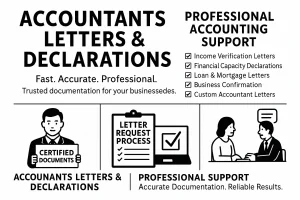
 Accountant’s Letter & Declaration: What Bank Needs From You
When you ask a bank for credit, they don’t have many options to confirm your income.
If you’re an employee, they’ll ask for pay stubs, PAYG summaries (now called income statements), and tax returns. These are hard to fake.
But if you run a business? That’s different. All the numbers come from you. And banks know this. So they usually ask for a letter or declaration from your accountant. This certifies that the information you’re supplying is accurate.
What It Is
An accountant’s letter is a signed document from a qualified accountant. It confirms your declared income is correct.
Sometimes you self-declare first, and the accountant backs it up. Other times the letter stands alone – called a no-doc loan.
But here’s the catch. When a bank accepts an accountant’s letter, they do minimal checking. If the loan goes bad, it falls back on the accountant.
We issue hundreds of these letters. Each one carries risk and takes time.
Why Banks Want It
Low-doc loans are popular with self-employed people. Less paperwork upfront. Just certify your income and get your accountant to sign off.
Along with bank statements and BAS, an accountant’s letter proves your income is real.
If a bank is asking for this – usually at higher interest rates – it means your loan couldn’t be approved the normal low-risk way.
What Accountants Confirm
It’s not always about income. Banks ask us to confirm things like:
• Past earnings will continue
• An asset is for business use
• Loan is for business purposes
• You’ve had independent financial advice
• You can actually repay the loan
Common Reasons for an Accountant’s Letter
• Business is trading at a profit (or not)
• Explaining a one-off expense or income change
• Start-up or large expenses
• Contractor with no major expenses – gross income treated as net
• Change in ABN or structure – beneficial interest unchanged
• Family employees only
• Complicated ownership – confirming who owns what
• Loan purpose – business or personal
• Guarantor has received financial advice
What a Proper Letter Must Include
• Firm letterhead with contact details and ABN
• CPA or industry membership info
• Name of signing accountant
• Who the letter is addressed to
• Statement confirming the firm is your accountant
• Disclaimer (most accountants insist on this)
Most lenders accept a copy. Some want the original.
How Much Does It Cost?
It depends on:
• Type of letter
• How much information needs verifying
• Time taken
We charge a fee based on the effort. It’s not just a signature – there’s real risk and due diligence involved.
Before We Sign, We Ask Four Questions
1. Is it reasonable?
2. Is it within scope of our service agreement?
3. Is it feasible for you to achieve?
4. Can we substantiate it with records?
If the answer to any is no, we can’t issue the letter.
The Bottom Line
An accountant’s letter can help you get a loan approved – especially if you’re self-employed. But it’s not a rubber stamp. It takes time, verification, and carries real risk for your accountant.
If your bank asks for one, talk to your accountant early. Be upfront. And expect a fee – because getting it right matters.